2450410*

$55.99 $52.29 price per bottle Expert Advice

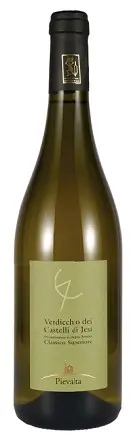
Wine maker notes A brilliant expression of Castelli di Jesi, made with grapes grown in clay- and limestone-rich soils. This Verdicchio is fresh, with citrus notes and a rich finish.
Other text Pievalta was founded in 2002 when Franciacorta’s Barone Pizzini bought 27 hectares in the Castelli dei Jesi denomination, located on the two slopes of the Esino river valley; 22 hectares are on the left bank of the Esino at Majolati Spontini, while 5 hectares are on the right bank at San Paolo di Jesi. This is important because the Esino’s left bank has soils that are mostly marly-clay (giving fresher, more lifted wines), while the right bank is characterized by sand and compacted sandy soil that gives more structured wines. Pievalta is also famous for farming organically since the beginning, and in 2005 it became fully biodynamic (Demeter certified in 2008). From New Releases from the Marche: Life Beyond Verdicchio? (Feb 2018) by Ian D’Agata
Producer The Pievalta winery is located in Maiolati Spontini township, Ancona province, in the Marches (Marche), in the heart of the Castelli di Jesi. It’s a land renowned for its small, walled medieval villages and for the production of wines made from Verdicchio grapes. Pievalta was founded in 2002 thanks to the vision of the Barone Pizzini winery (Franciacorta). At the time, the historic estate in Lombardy was thinking of investing outside its own appellation. The winery’s CEO, Silvano Brescianini, had already recognized the great potential of Verdicchio as one of Italy’s most important indigenous grape varieties. And so he decided to gamble on the Marches, a region rich in history and natural resources and one of Italy’s most beautiful landscapes. Barone Pizzini asked a young Milanese enologist, Alessandro Fenino, who had worked a few harvests at the winery in Franciacorta to manage this ambitious project in the Castelli di Jesi appellation. Alessandro left Milan and headed to Maiolati Spontini where he began to study Verdicchio and immediately fell in love with it. From the outset, he farmed the estate organically and in 2005 it was only natural that he would begin a biodynamic conversion of the vineyards. Biodyanmic grape-growing means bringing the soil back to life by helping it reactivate the forces that keep it in balance with the sky and the earth. He grows cover crops between the vineyard rows and he treats them with biodynamic preparations to facilitate the formation of fertile hummus. Through his deep respect for the terroir, he has revitalized the growth of other plants as well. “We don’t transform grapes into wine,” says Fenino. “We simply accompany the fruit as it become wine. We always stay one step behind and we don’t intervene or use shortcuts that would interrupt its harmony with the place where it is made. Instead, we let the grapes express themselves freely. Anyone who travels through these hills will see and taste this. ” The estate covers 26. 5 hectares with 21. 5 hectares in Maiolati Spontini around the winery. Many of the vines were planted in the 1970s. Today, they have been re-trellised using modern training systems and higher density. In Maiolati Spontini, the subsoils are primarily clay and limestone. The other vineyard is located in San Paolo di Jesi in the hamlet of Follonica. It’s a high-elevation site with good ventilation and the classic granitic sandstone that makes Castelli di Jesi an ideal place to produce fine wine. In 2008, Alessandro was joined in Pievalta by Silvia Loschi, his colleague from Franciacorta and his life partner. She manages sales and hospitality at the winery.
| ABV: | - |
| Distillery: | - |
| Vintage: | 2018 |
| Region: | Marche |
| Size: | 750 ml |
| Availability: | In Stock |
| Distributed by: | BLW |


Choose your shipping destination so we may show you products that can be delivered to you




 0
0