1077422*

$54.99 $51.49 price per bottle Expert Advice

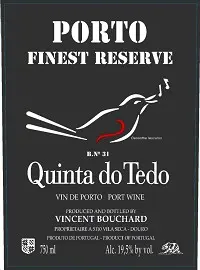
Porto made from the previous 3 classic Port vintages and aged for a minimum of 2 years in 550 liter French barrels (demi-muids). 10,000 bottles annually. Producer n 2001 UNESCO declared the Douro Valley a World Heritage Site because it represents a unique example of people’s relationship with nature. There is evidence that Romans grew vines (and olives and cereals) on its steep slopes, and certainly in Medieval times Cistercian monks expanded terraces and cultivated vines at three monasteries along the river. “Port wine” was mentioned in the written record as early as 1675, a time when the viticulture was expanding and gaining in importance. The 1703 Methuen Treaty between England and Portugal specifically opened the wine trade between the two countries (England was looking for a source of wine other than France, its nemesis), and led to the establishment of English Port lodges. In one of the earliest examples of a formal wine demarcation, the Portuguese government drew up geographical boundaries for Douro Valley wine production in 1756. These boundaries closely paralleled the band of schist that lines either side of the river for 60-odd miles, hemmed in by granite. With some modification, the border remains in place today, but the demarcation applied only to fortified wine up to 1979. Until the late 20th century, fortified wine ruled the roost, although signs of insurrection appeared in the middle of that century. In 1952 an enologist named Fernando Dicolau de Almeida launched Barca Velha. He worked for the house of Ferreira but was inspired by Bordeaux. His creation would become the iconic dry red wine of the Douro, but would remain little more than a nuisance to Port’s dominance in the decades to follow. That dominance legally ended in 1986 when Portugal joined the EEC, resulting in the revamping of Port production laws and letting growers bottle their production rather than forcing them to sell it to the lodges and shippers. The 1990s consequently witnessed an outbreak of top quality dry wines, and Barca Velha’s relative isolation came to an end. It was at that time that Vincent Bouchard, scion of the Burgundy Bouchard Pere et Fils family, purchased Quinta do Tedo. He had lived most of his life in California, where he had gone in 1979 and by dent of hard work became the primary broker of French barrels to American wineries. He married a Californian and raised a family. In 1989, he visited the Douro Valley with his wife, Kay. The experience proved to be transformative, and Vincent returned time and again to hike through the vineyards of the Alto Douro, Port’s finest appellation (this is the downriver zone, closest to the coastal region and thus the coolest), until he came across Quinta do Tedo. Vincent wanted to make world class Port and dry wine; the quinta met every criteria. He bought it in 1992, a virtual ruin. Kay and he spent the first winter huddled around the huge old ancient fireplace where they cooked their meals, the kitchen floor a minefield of pots placed about to catch the rain leaking through the roof. They spent the next twenty years renovating the physical plant and replanting vineyards. Quinta do Tedo is classed as a Single Quinta, or estate, meaning that its production comes entirely from its own vineyards. These vineyards are further classed “A,” equivalent to grand cru, in a ranking system devised by the authorities going from A to F. Less than 3% of all domains in the Douro are classed as either A or B. In addition to fruit and olive orchards, there are 14 hectares (35 acres) of vines growing on the quinta’s terraces. The quinta is located within an ecological preserve, and its vineyards are farmed organically with the aid of a horse and workers, and harvested by hand. The vineyards are broken down as follows: 10 hectares (25 acres) of 22 varieties of old vines planted on the steepest terraces. Most of these vines date from the 1950s and 60s, except for one hectare named Savedra that dates from the 1920s (and that typically yields one bunch per vine!). 1. 5 hectares (4 acres) of Touriga Nacional, planted in 1997. Touriga Nacional makes deeply colored, concentrated, tannic wine. 1 hectare (2. 5 acres) of Tinta Roriz (a. k. a. Tempranillo), planted in 1998. Prized for fruit and structure but commonly blended in the Douro to avoid oxidation. 0. 5 hectare (1. 25 acres) of Tinta Barroca, planted in 1998. A hearty grape giving length. 0. 5 hectare (1. 25 acres) of Touriga Francesa, planted in 1998. Prized for perfume, acid, and length. 0. 5 hectare of Tinto Cao (translates as red dog), planted in 1997. Long history in the Douro but nearly disappeared until it was identified recently as one of Port’s finest grapes. Noted for tannic structure. The 18th century quinta sits on the south side of the Douro River at its confluence with the smaller Tedo (Dirk Niepoort’s much more publicized quinta is maybe a mile upriver on the Tedo). Its 10 hectares of mixed old vines is normal for a vineyard of the Douro, where more than 90 varieties are permitted for use in fortified wine production. All of those varieties are native to the Iberian Peninsula. Indeed, as far as indigenous varieties are concerned, Portugal went through most of the 20th century in splendid isolation, resulting in the preservation of hundreds of native wine grapes-a remarkable treasure that is still largely unstudied. The other thing that is all but unique to the Douro is that huge stretch of schist, a metamorphic rock that was formed in horizontal layers. A seismic upheaval subsequently turned this rock on its side, which today allows the vine roots to penetrate down between the layers in their search for water. Comparable vineyard ground to this can be found in AOC Savennieres in the Loire Valley and in AOC Faugeres in Languedoc, where schist was also upturned, but on a far more constrained scale. Both appellations are noted for their distinctly mineral wines. The possibility and potential of the Douro are what captivated Vincent. He understood that great wines could be made here, especially if one went to lengths to preserve freshness and purity of fruit (he has no tolerance for oxidation during the fermentation and aging processes). To that end, Quinta do Tedo has the distinct advantage of being a small domain with all of its vineyards around the winery, thus the distance the grapes must travel after picking is minimal. Harvest is by hand in the mornings, and the grapes are de-stemmed entirely, then crushed traditionally-and systemically in stages-by feet in lagares. A lagare is an open fermentation tank, in this case two and a half feet deep, made of granite. Vincent improved upon this traditional vessel by lining the sides and bottom of his lagares with water pipes, enabling him to cool and control the temperature. Once in barrel, the wines are topped off assiduously and never fined. Vincent makes his Ports and wines with the aid of enologist-and business partner- Jorge Alves, who is an avid wine aficionado pursuing his Master of Wine. Currently 20% of the production is in table wine, the remainder in Port.
| ABV: | - |
| Distillery: | - |
| Vintage: | - |
| Region: | Duriense |
| Size: | 750 ml |
| Availability: | In Stock |
| Distributed by: | BLW |


Choose your shipping destination so we may show you products that can be delivered to you




 0
0